Like every year, LEAP was a total whirlwind of insightful conversations and live demos. This year, as the tech community makes meaningful strides in the world of AI, we have reimagined some pretty awesome new possibilities together.
Here is a summary of the key insights and topics we presented at our booth this year.
1. You can reimagine the buying journey with agentic AI
We demonstrated how agentic AI can potentially reshape the entire customer journey, from first touchpoint to checkout, cutting friction and boosting conversion along the way.
AI agents have the ability to guide shoppers with natural, interactive conversations that reduce decision fatigue and drop-off rates.
Did you know?


Your AI agent can work towards eliminating sales friction at checkout, directly boosting sales performance, leading to higher conversion rates.
2. Payment follow-ups and collections can be automated
Agentic AI can handle proactive follow-ups and payment collection without constant human intervention, speeding up cash flow and freeing up teams.
Rather than relying on manual outreach or rigid scripts, an AI agent engages customers calmly and conversationally across multiple channels, including voice calls and messages. It can actively listen, answer inquiries, and present tailored payment options without judgmental or high-pressure tactics.
It can even help clients set up flexible installment plans or provide settlement arrangements. But when complex negotiations arise or human intervention is required, the AI agent seamlessly escalates the call to the collection team with full context, ensuring a smooth transition without repeating information. By automating routine follow-ups, businesses reduce missed payments, allowing human agents to focus on high-priority negotiations.
3. Simplifying appointment management has never been easier
Scheduling headaches are now officially a thing of the past. Managing appointments manually often leads to double-bookings, missed slots, and endless back-and-forth communication. We walked through how an AI agent can handle complex scheduling end-to-end, seamlessly integrating with existing calendar software and customer databases to book, reschedule, or cancel appointments in real time. By automating routine booking requests across multiple channels, businesses eliminate double-bookings, reduce no-shows with automated reminders, and deliver a smooth, instant booking experience for customers.
4. Designing an agent that sounds like your brand just makes sense
Your AI agent should sound like your best employee, not a generic, dry bot. Inconsistent responses and varying brand representation hurt customer trust. At LEAP, we covered how to build an AI agent tailored specifically to your business in minutes using Maqsam's AI Agent Studio.
By training the agent on your own knowledge base, custom workflows, and distinct dialect or brand guidelines, you ensure a single, consistent voice across every interaction.
5. Gaps in your CX are avoidable with smart analytics
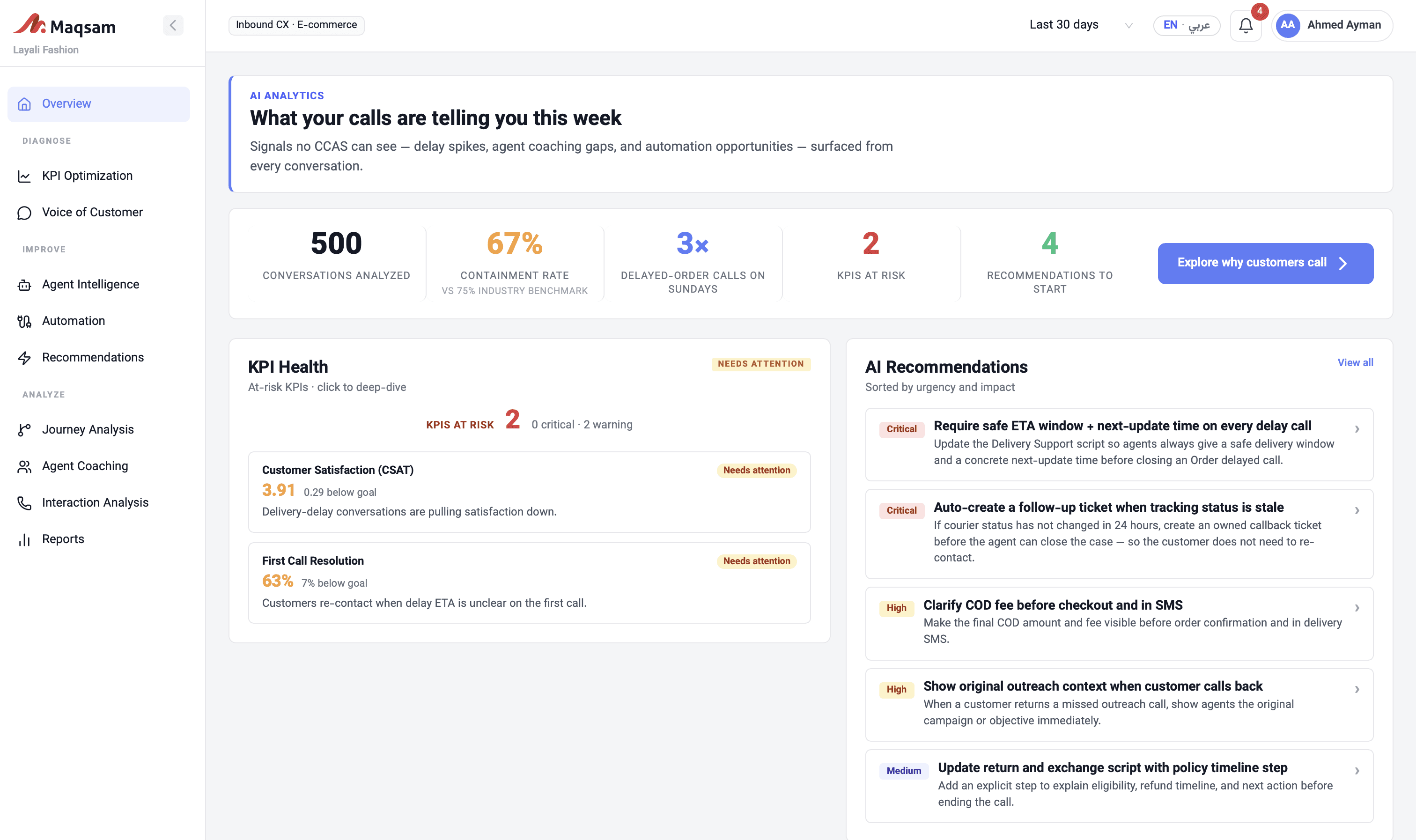
Some customer experience gaps never show up in standard metrics or high-level KPIs. Traditional customer service tracking often misses subtle friction points, such as hidden drop-off moments, unresolved micro-queries, or silent customer frustration. By implementing AI-driven analytics, businesses can continuously monitor conversation patterns and surface critical CX flaws before they begin negatively impacting brand loyalty and retention.
Smart analytics automatically flag recurring issue trends, identify agent knowledge gaps, and pinpoint exact workflow bottlenecks across support channels. Armed with these actionable insights, service leaders can proactively refine support scripts, streamline agent workflows, and resolve operational roadblocks long before customers feel the strain.
6. Boosting your sales performance with smart analytics is the way forward
While sales managers can easily track end-of-quarter revenue figures and deal metrics, traditional dashboards fail to explain the root causes behind these outcomes.
Smart conversation analytics bridges this gap by automatically evaluating every sales call to deliver deep, operational insights into performance drivers:
Detecting At-Risk Deals: Identifies subtle indicators of prospect hesitation, competitor mentions, or declining engagement.
Uncovering Winning Talk Tracks: Pinpoints the specific phrases, value propositions, and messaging patterns used by top performers that consistently convert prospects into closed deals.
Tracking Recurring Objections: Categorizes common pushbacks, such as pricing concerns ("it's too expensive"), timeline delays ("I need more time"), or competitor comparisons ("I found a cheaper alternative"), and prepares teams with effective counter-arguments.
Identifying Individual Skill Gaps: AI can make the sort of recommendations your sales team needs to improve, for example, it can train employees on how to handle price objections, if there is a regular shortcoming as evidenced from real calls.
Our dashboard also features a team leaderboard, where your best employees are ranked by performance and can be rewarded based on merit.

Missed out?
Missed a session or want to go deeper on any of these learnings?
We'd love to continue the conversation.
Book a call today.